You have probably seen the words “biotech beauty” and thought: what on earth does that actually mean?
You are not alone. The term sounds like something out of a science fiction film. But the truth is much simpler — and honestly, quite exciting. Biotech organic beauty products are skincare, beauty items using the latest tech making plant-based ingredients work better than ever. Think of it as nature getting a very clever upgrade.
What does biotech organic beauty actually mean, how it works, which brands are leading the way, and why it might be the most important shift in skincare.
What Does “Biotech Organic Beauty Products” Actually Mean?
Let us break the name into two parts.
“Organic beauty” means the ingredients come from plants, not synthetic chemicals cooked up in a factory. Things like plant oils, botanical extracts, and naturally-derived acids.
“Biotech” — short for biotechnology — the science of using living organisms (like plants, yeast, or bacteria) to create or improve things. In beauty, it means scientists are using biological processes to supercharge plant ingredients, so they work harder and penetrate deeper.
Biotech organic beauty products use science to enhance natural skincare ingredients.
Why Do We Need Science to Improve Natural Ingredients?
Here is the honest truth: raw nature is wonderful, but it has limits.
Many natural ingredients are unstable — they break down when exposed to light or air before they can do anything useful. In their natural form, others lack the concentration to make a visible difference. Some come from endangered species or require massive amounts of farmland to produce.
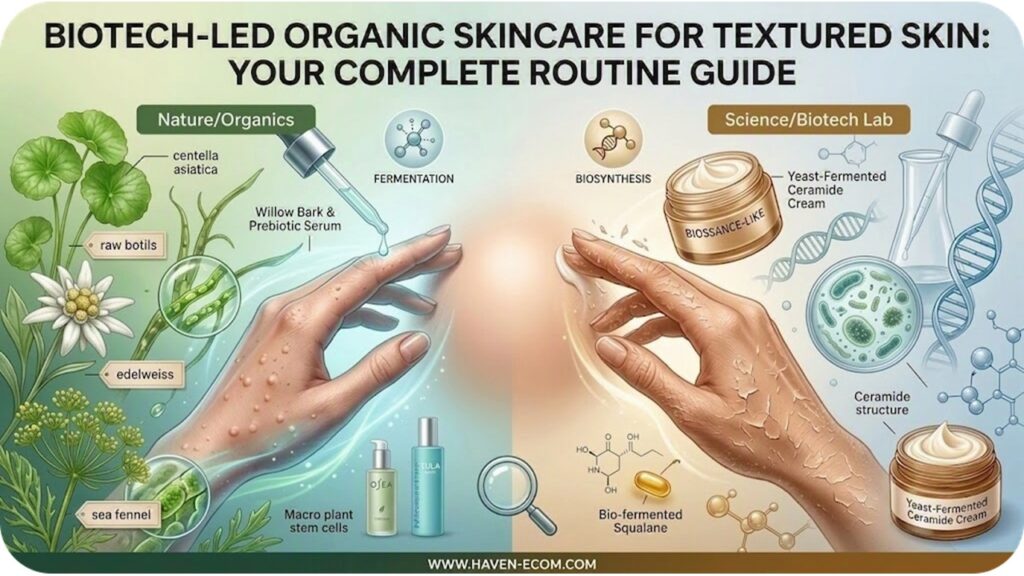
Biotechnology solves these problems. Using techniques like fermentation, plant stem cell extraction, and biosynthesis (making nature-identical ingredients in a lab), scientists can:
- Make ingredients smaller so they absorb more easily
- Concentrate them for greater effectiveness
- Stabilize them so they do not break down
- Recreate them sustainably without depleting natural resources
The result is clean, plant-based skincare that actually delivers on its promises.
How these 3 Key Processes Create Biotech Organic Beauty Products
Fermentation — The Sourdough Method
You already know fermentation from food — yoghurt, sourdough bread, kombucha. In beauty, scientists use the same principle. Scientists introduce bacteria or yeast to plant ingredients and allow them to ‘digest’ the mixture over time over time. This process breaks down the plant molecules into smaller, more potent particles. The result is an ingredient that absorbs into your skin far more effectively and causes far less irritation than its unfermented version. Fermented lactic acid, for example, is gentler and more hydrating than standard lactic acid.
Plant Stem Cell Extraction — Growing Power From Seeds
Every plant has stem cells — the master cells responsible for growth and repair. Scientists have found ways to extract and cultivate these cells in a controlled laboratory environment. his creates a highly concentrated active ingredient that triggers your skin’s natural repair mechanisms, eliminating the need to harvest enormous quantities of the plant. In fact, the world’s most effective anti-ageing skincare products now use these sustainably sourced ingredients from sea fennel, edelweiss, and gotu kola.
Biosynthesis — Recreating Nature in the Lab
Sometimes the best thing nature makes is difficult to source sustainably — or comes from places we should not be taking it from. Biosynthesis allows scientists to recreate these molecules in a laboratory using plant-based starting materials. Biotech creates an ingredient chemically identical to the natural version while protecting animals, preserving forests, and guaranteeing a completely reliable supply.
Top Biotech Organic Beauty Brands — Who Is Doing This Well?
BIOEFFECT — Iceland’s Plant Stem Cell Pioneer
BIOEFFECT is one of the most scientifically rigorous biotech organic beauty brands in the world. Founded in 2010 by three Icelandic scientists, the brand spent years developing the world’s first plant-based Epidermal Growth Factor (EGF) — a protein your skin naturally produces to repair and rejuvenate itself. As we age, EGF production drops sharply, which contributes to wrinkles and sagging skin.
BIOEFFECT’s scientists cracked how to grow a plant-based replica of this exact protein inside barley seeds, in a geothermal greenhouse in Iceland powered entirely by clean energy. Clinical studies show their EGF serum can improve skin thickness by up to 60% and density by 30%. It is biotech and organic principles working together at the highest possible level.
Learn more: Visit the Bioeffect Store
Biossance — The Brand That Saved Two Million Sharks
If you have ever used a squalane product, there is a good chance Biossance is involved. Squalane is a moisture molecule that mimics the skin’s own natural oils perfectly — and it used to be sourced from shark livers. Biossance’s parent company, Amyris, figured out how to ferment sustainably grown sugarcane using biotechnology to create a squalane molecule that is chemically identical to the shark-sourced version but 100% vegan, cruelty-free, and carbon-neutral in production.
This is biosynthesis in its most impactful form — a biotech discovery that is saving an estimated two million sharks per year while delivering genuinely exceptional skincare.
Learn more: Visit the BIOSSANCE Store
Tula Skincare — Probiotic Power for Your Skin
TULA applies the science of the skin microbiome — the community of billions of bacteria that live on your skin and determine how healthy, clear, and balanced it looks — to its product range. Their biotech organic beauty formulations include pre- and probiotics that support and strengthen this microbiome, helping to reduce inflammation, calm redness, and create a healthier skin environment from the inside out.
Learn more: Visit the TULA Store
Bakuchiol Botanicals (Herbivore, Pai, Ayuna) — The Plant Retinol Revolution
Retinol (Vitamin A) is one of the most proven anti-ageing ingredients in skincare — but it causes dryness, peeling, and sun sensitivity for many people, and it is not considered safe during pregnancy. Bakuchiol, extracted from the seeds of the babchi plant using biotech stabilisation processes, has been clinically shown to deliver comparable results to retinol in reducing fine lines and improving skin tone — with significantly fewer side effects.
A landmark 12-week double-blind clinical study published in the British Journal of Dermatology found that bakuchiol performed comparably to retinol in treating photo ageing, but was better tolerated with less skin scaling and irritation. This is a plant-derived biotech ingredient changing millions of people’s skincare routines.
Read the clinical study: Bakuchiol Botanicals
Are Biotech Organic Beauty Products Safe?
Yes — in fact, they are often safer than their conventional counterparts, for a few reasons.
Because biotech processes allow for such precise control over the ingredient, the risk of contamination or inconsistency is dramatically lower. Because many of these ingredients are nature-identical (meaning they are structurally the same as molecules your skin already produces), they are less likely to cause reactions. And because they are derived from organic, plant-based starting materials rather than petroleum or synthetic chemicals, they are free from many of the harsh irritants found in conventional skincare.
That said, all skincare — biotech or otherwise — can cause reactions in some people. A patch test is always a sensible first step with any new product.
Are Biotech Organic Beauty Products Better for the Planet?
This is one of the most compelling arguments for the category. Traditional ingredient harvesting can be devastating — from the deforestation caused by palm oil farming to the decimation of shark populations for squalene, to the over-farming of lavender and other botanicals.
Biotechnology offers an alternative: lab-grown and fermentation-derived ingredients that require a fraction of the land, water, and energy of traditional extraction — and produce zero animal harm. Biossance’s squalane facility in Brazil, for example, uses sugarcane waste to generate the electricity that powers the entire production process.
The Simple Summary
Biotech organic beauty products are not complicated or intimidating once you understand the idea. They take the best of nature — plants, fermentation, biological processes — and use science to make natural ingredients work better. While being gentler and more sustainable than conventional alternatives.
You do not need a science degree to benefit from them. You just need to know what to look for — and now you do.
Sources — Verified Facts Behind This Post
Every claim in this article is backed by peer-reviewed research or official brand science pages. Click any link below to verify the information directly.
Biotech Beauty Science & Market Research
- Raquel New York — Biotech Skincare: The Next Frontier. Overview of biotechnology methods used in modern skincare, including fermentation, plant stem cell culture, and biosynthesis. https://raquelnewyork.com/biotech-skincare-the-next-frontier/.
- Covalo Industry Blog — Biotech in Beauty: A Round-Up of Science-Driven Brands. Independent industry overview of biotech beauty brands including BIOEFFECT and NeoGenesis. https://blog.covalo.com/personal-care/biotech-in-beauty-round-up-of-science-driven-brands.
- Covalo Industry Blog — The Future of Biotech in Beauty: Redefining ‘Natural’ — Covers fermentation science and sustainable ingredient production. https://blog.covalo.com/personal-care/the-future-of-biotech-in-beauty-redefining-natural
- KBL Cosmetics — How Is Biotechnology Used in Beauty Product Formulation? — Technical explanation of plant cell culture, fermentation, and active ingredient development. https://kblcosmetics.com/blogs/news/how-is-biotechnology-used-in-beauty-product-formulation
- Cultiply — Biotechnology in Cosmetics: Key Benefits & Trends — Covers L’Oréal, Biossance, Estée Lauder, and plant stem cell technologies. https://cultiply.net/en/biotechnology-in-cosmetics-applications-benefits-and-key-trends/
Bakuchiol — Clinical Evidence
- PubMed / British Journal of Dermatology — Prospective, Randomized, Double-Blind Assessment of Topical Bakuchiol and Retinol for Facial Photoageing . The landmark peer-reviewed clinical study confirming bakuchiol is comparable to retinol with better tolerability. https://pubmed.ncbi.nlm.nih.gov/29947134/
- National Institutes of Health (NIH/PubMed) — Plant Stem Cells in Cosmetic Industry . Peer-reviewed review article confirming the safety, sustainability, and efficacy of plant stem cell extracts in skincare. https://www.ncbi.nlm.nih.gov/pmc/articles/PMC11820651/
- National Institutes of Health (NIH/PubMed) — Plant Stem Cell Extract from Coffea Canephora Shows Antioxidant, Anti-Inflammatory, and Skin Regenerative Properties. Scientific study on plant stem cell actives in cosmeceuticals. https://www.ncbi.nlm.nih.gov/pmc/articles/PMC10313218/
All sources were verified and active as of June 2026.